
Stuck wondering what to post on LinkedIn? Discover 25 practical LinkedIn post ideas to turn your work experience, lessons, opinions, and expertise into authentic content.
- LinkedIn Post Ideas
- LinkedIn Content Ideas
- LinkedIn Content Strategy
- Personal Branding
- AI Writing
- Professional Branding
- LinkedIn Marketing
- Content Creation
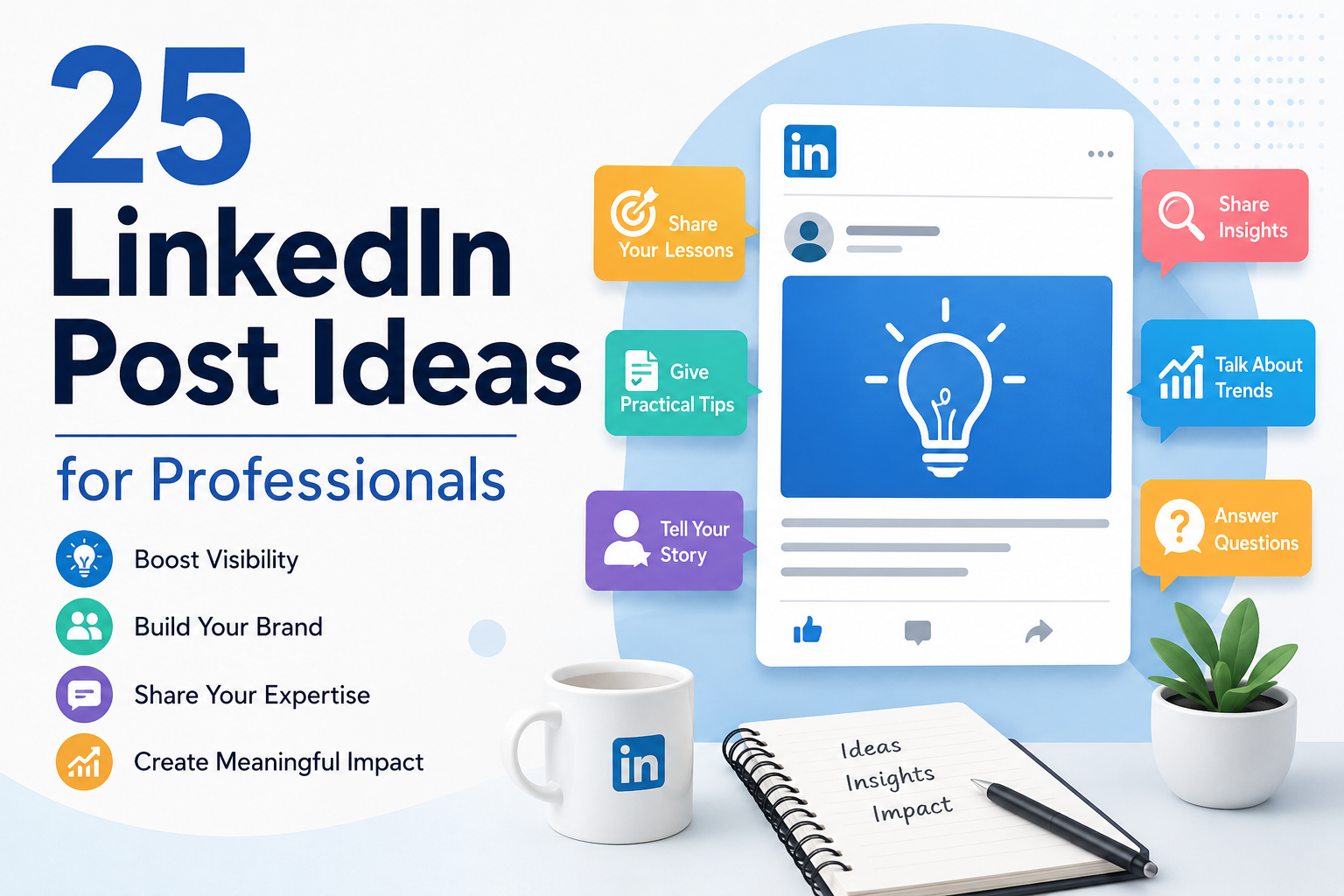
You know LinkedIn can help build your professional reputation.
You have experience. You have opinions. You probably solve problems every week that other professionals would find valuable.
Yet when it is time to create a post, one question stops everything:
“What should I post about?”
The problem is rarely a lack of expertise. Most professionals simply don't have a system for turning their everyday work, experiences, lessons, and ideas into content.
You don't need to invent something groundbreaking every time you post. Some of the best LinkedIn content starts with something simple you already know.
If you need a structured way to develop your ideas, Propost can help you turn your professional experience into content while maintaining your own writing style.
Here are 25 practical LinkedIn post ideas to help you get started.
1. Share a Lesson You Learned the Hard Way
Think about a mistake that changed how you work. What happened? What did you learn? What would you do differently today?
Post starter: “One mistake I made early in my career was...”
A real lesson is usually more valuable than generic advice.
2. Explain Something People Often Get Wrong
Every industry has common misconceptions. Choose one and explain what people misunderstand.
Post starter: “One thing people often get wrong about [your industry] is...”
This format works well because it gives you a clear point of view.
3. Turn a Recent Work Challenge Into a Lesson
You don't need to share confidential information. Describe the challenge at a high level and focus on the learning.
Post starter: “This week, I was reminded that solving [challenge] requires more than...”
4. Share Your Most Useful Professional Framework
Do you use a checklist, decision-making model, or process repeatedly? Turn it into a post.
For example:
- Cost
- Risk
- Long-term impact
- Stakeholder alignment
Simple frameworks are easy to understand and give your audience something practical to apply.
5. Write About a Career Turning Point
Was there a conversation, project, failure, promotion, or decision that changed your career direction?
Tell the story and explain what changed in your thinking.
6. Share a Before-and-After Lesson
Compare how you approached something earlier in your career with how you approach it today.
Post starter: “Five years ago, I believed [X]. Today, I see it differently...”
This format naturally demonstrates professional growth.
7. Answer a Question You Are Frequently Asked
If colleagues, customers, or friends repeatedly ask you the same question, it is probably a good content idea.
Write the answer once as a useful LinkedIn post.
8. Share an Industry Observation
What is changing in your profession?
You don't always need to predict the future. Share what you are actually noticing and add your interpretation.
Post starter: “One shift I'm seeing in [industry] is...”
9. Explain How You Solve a Specific Problem
Choose one problem within your expertise and explain your process.
Useful structure:
The problem → Why it happens → How I approach it → What I learned
10. Share Something You Changed Your Mind About
Strong professionals evolve. Write about an opinion you previously held and what changed it.
Post starter: “I used to think [X] was the best approach. I no longer do. Here's why...”
11. Create a “What I Wish I Knew Earlier” Post
Think back to the beginning of your career. What advice would have saved you time or frustration?
Make it specific. Specificity creates credibility.
12. Share a Small Win and the Process Behind It
Not every achievement needs to be a major promotion or award.
You can write about improving a process, solving a difficult problem, completing a project, or reaching a professional milestone. Explain how you achieved it.
13. Write About a Tool You Actually Use
Share how a tool improves part of your work.
- What problem did you have?
- How did you use the tool?
- What changed?
- Where does it not work perfectly?
Honest experiences are more credible than advertisements.
14. Share Your Decision-Making Process
People often find the thinking behind a decision more useful than the decision itself.
Post starter: “When I have to choose between two important options, I ask these five questions...”
15. Turn a Meeting Into a Content Idea
After your next interesting meeting, ask:
“What did we discuss that others in my profession might find useful?”
A disagreement, lesson, customer question, or new perspective could become your next post. Never share confidential information, but don't overlook the ideas your daily work already generates.
16. Share a Contrarian Opinion—With Evidence
You don't need to disagree just to get attention. But if you genuinely see something differently, explain why.
Post starter: “I don't think [popular approach] is always the right answer. In my experience...”
The goal is not controversy. The goal is a useful perspective.
17. Create a “Three Things I Learned” Post
When you are short on time, choose a topic and share three useful observations.
- Three things I learned from managing a difficult project
- Three mistakes I see in my industry
- Three ways AI is changing my daily work
Keep each point specific and useful.
18. Explain a Complex Topic Simply
Your expertise may include concepts that seem confusing to others. Break one down in plain language.
If someone outside your profession can understand the post, you have probably explained it well.
19. Share an Unexpected Professional Lesson
Some of the best career lessons come from unexpected places.
A customer conversation, project failure, travel experience, hobby, or personal observation may have changed how you approach your work.
20. Write About What You Are Currently Learning
You don't need to wait until you become an expert.
Share what you are learning now.
Post starter: “I'm currently learning more about [topic]. One thing that surprised me is...”
This allows you to learn publicly while adding your own professional perspective.
21. Share a Professional Habit That Saves You Time
What do you consistently do that improves your work?
It could be a weekly review, meeting preparation method, decision log, checklist, or note-taking system.
22. Turn Data Into an Insight
If you work with metrics, don't simply post the number. Explain what it means.
Weak: “We improved efficiency by 20%.”
Stronger: “Improving efficiency by 20% wasn't the biggest lesson. The biggest lesson was identifying which part of the process was creating the delay.”
The insight behind the data is often more valuable than the number itself.
23. Write a “Then vs. Now” Post
Compare how your industry, role, or approach has changed.
Post starter: “When I started in [industry], we used to focus mainly on [X]. Today, the conversation has shifted toward [Y].”
24. Share Your Advice to Your Younger Self
Imagine you could send one message to yourself on your first day in the profession.
What would it say?
Avoid generic advice and focus on something you genuinely learned through experience.
25. Create a Content Bank From Your Everyday Work
The best solution to “What should I post?” is to stop searching for ideas only when it is time to publish.
Create a simple content bank and capture:
- A problem you solved
- A question someone asked
- A mistake you learned from
- An industry change you noticed
- A process you improved
- A useful conversation
- A new opinion
- A professional lesson
You don't need to write the complete post immediately. Just capture the idea.
If you want help organizing those ideas into content, start with an AI-powered LinkedIn content workflow that helps you move from an idea to a draft without starting from a blank page.
How to Turn One Idea Into Multiple LinkedIn Posts
Suppose your original idea is:
“A project failed because stakeholder ownership was unclear.”
That single experience can become multiple posts:
- Post 1: The mistake you made
- Post 2: Three signs ownership is unclear
- Post 3: Your framework for defining accountability
- Post 4: What you would do differently today
- Post 5: A contrarian opinion about stakeholder meetings
You don't need 100 different experiences. You need to learn how to extract multiple perspectives from the experiences you already have.
Stop Waiting for the Perfect Idea
The biggest mistake is believing every LinkedIn post needs to be original, profound, or viral.
Your audience doesn't need another generic quote.
They want useful perspectives from someone with real experience.
Start with what you know.
Share what you learned.
Explain how you think.
Add your own opinion.
Then use AI to help organize and develop the idea—not replace the experience behind it.
If you're still unsure where to begin, start with one question:
“What happened during my work this week that taught me something worth sharing?”
The answer might already be your next LinkedIn post.
Turn Your Experience Into Content With Propost
You already have ideas. They may be hidden inside meetings, projects, challenges, mistakes, conversations, and professional experiences.
The challenge is turning those ideas into consistent content.
With Propost, you can build content around your expertise and preferred writing style, develop new post ideas, create drafts, review the output, and stay in control before publishing.
Your experience creates the idea. Your voice keeps it authentic. AI helps you turn it into a post.
Start creating LinkedIn content that sounds like you with Propost.
Ship LinkedIn posts in your voice
Draft, approve, and publish with Propost — start free, no card required.
Also explore: Pricing · Free LinkedIn tools · Blog · Resources