
Discover 50 practical LinkedIn hooks to capture attention and encourage more people to read your posts. Use these proven hook formats and adapt them to your own voice.
- LinkedIn Hooks
- LinkedIn Post Hooks
- LinkedIn Content
- LinkedIn Writing
- Content Creation
- Personal Branding
- LinkedIn Engagement
- AI Writing
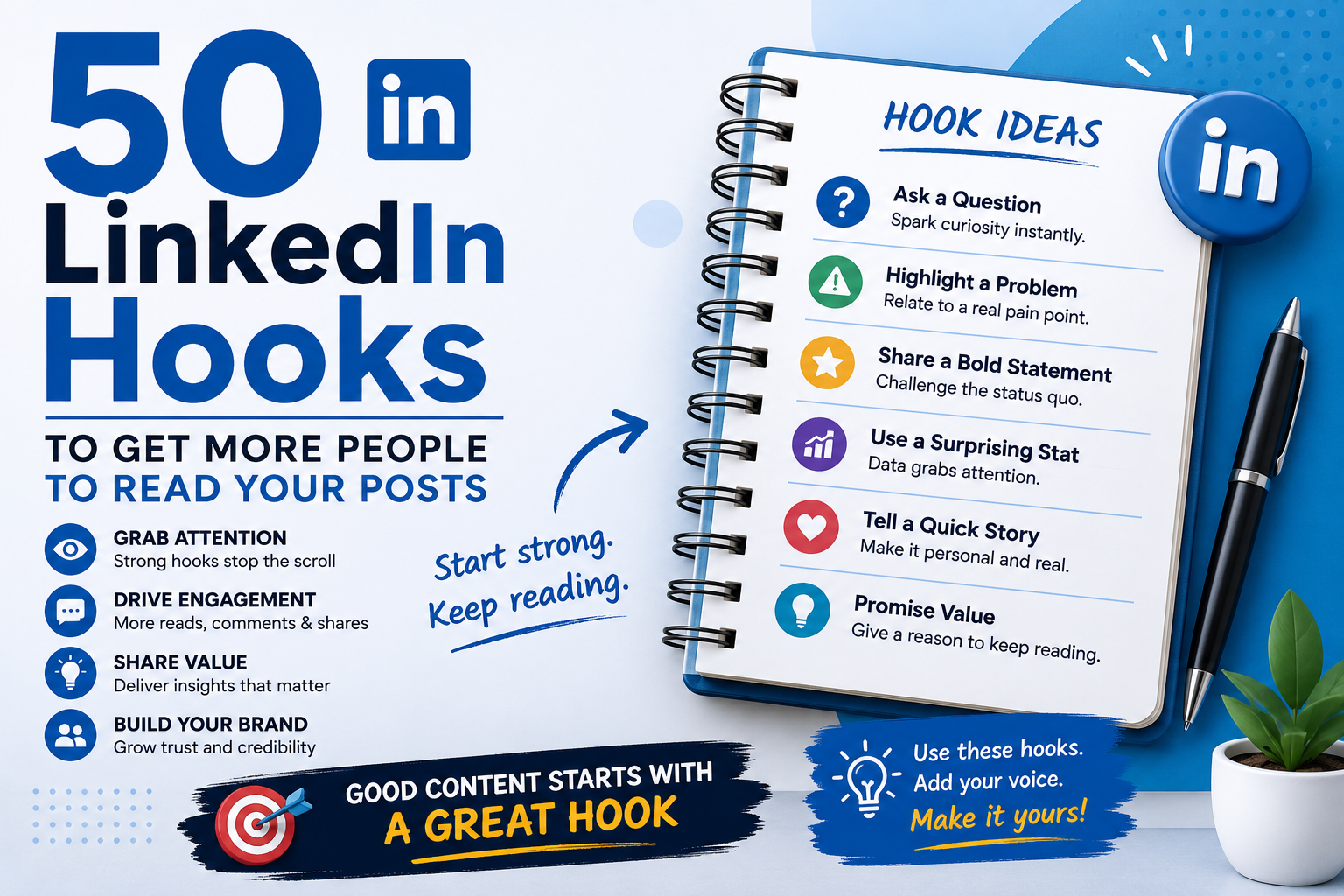
You can have a valuable idea, strong expertise, and useful advice—but none of it matters if people don't stop to read your LinkedIn post.
That is why the first few lines matter.
Your opening, commonly called a LinkedIn hook, gives readers a reason to continue. It doesn't need to be dramatic, controversial, or artificially inspirational. The best hooks create curiosity, identify a relevant problem, share a strong perspective, or make a useful promise.
A good hook should match the content that follows. Clickbait may attract attention, but it damages trust when the rest of the post fails to deliver.
Here are 50 LinkedIn hooks you can adapt to your own experience, industry, and writing style.
What Makes a Good LinkedIn Hook?
A strong LinkedIn hook usually does at least one of these things:
- Creates curiosity
- Identifies a problem
- Challenges a common belief
- Shares a surprising lesson
- Makes a useful promise
- Starts with a relatable experience
- Uses a specific observation or number
The goal is simple: give the right person a reason to read the next line.
1. Problem-Solving Hooks
1. If you're struggling with [problem], this might help.
Start by identifying a problem your audience already recognizes.
2. The biggest mistake I see people make with [topic] is...
This works when you can explain the mistake with real experience.
3. I spent [time] trying to solve this problem the wrong way.
A useful format for sharing mistakes and lessons.
4. Most people focus on [X]. The real problem is [Y].
Use this when your experience reveals a deeper issue.
5. There is a simpler way to approach [problem].
Follow with a practical process or framework.
6. If I had to solve [problem] again, I would start here.
This positions your advice around experience rather than generic instruction.
7. The hardest part of [topic] isn't what most people think.
Create curiosity, then explain the unexpected challenge.
8. I wish someone had explained this before I started [activity].
Excellent for career and professional lessons.
9. One small change made a bigger difference than I expected.
Share exactly what changed and why it mattered.
10. Here's how I approach [problem] when the usual solution doesn't work.
A good opening for professionals sharing practical expertise.
2. Contrarian and Opinion Hooks
11. I don't think [popular belief] is always good advice.
12. Unpopular opinion: [your genuine opinion].
Only use this when the opinion is genuinely yours.
13. Everyone says [X]. My experience has been different.
14. You probably don't need more [X]. You may need better [Y].
15. I stopped doing [common activity]. Here's why.
16. The advice I disagree with most in [industry] is...
17. More effort isn't always the answer.
Explain what should change instead.
18. Being busy and making progress are not the same thing.
19. The best decision isn't always the cheapest one.
Useful for procurement, business, technology, and leadership topics.
20. I changed my mind about [topic].
Then explain what experience changed your perspective.
3. Personal Experience Hooks
21. One conversation changed how I think about [topic].
22. I made a mistake that cost me [result or consequence].
Focus on the lesson rather than making the story unnecessarily dramatic.
23. Early in my career, I believed [X]. I was wrong.
24. A recent experience reminded me of something important.
25. This was one of the most difficult decisions I've had to make professionally.
26. I didn't expect this project to teach me so much about [topic].
27. Five years ago, I would have handled this completely differently.
28. One of my biggest professional lessons came from a failure.
29. I learned this lesson after making the same mistake more than once.
30. Looking back, I can see exactly where things went wrong.
4. Curiosity Hooks
31. I noticed something interesting this week.
32. There is one question I keep hearing lately.
33. This surprised me more than it should have.
34. I wasn't expecting this result.
35. Something changed in the way I approach [topic].
36. The most useful insight wasn't in the data.
37. I thought I understood this problem until I looked closer.
38. One detail completely changed my perspective.
39. The answer was simpler than I expected.
40. What happened next wasn't part of the plan.
5. Practical and Educational Hooks
41. Here are 3 things I check before making an important decision.
42. A simple framework I use for [task].
43. Before you do [activity], ask these 5 questions.
44. Three lessons I learned from [experience].
45. Here's the process I use to solve [problem].
46. If you're new to [industry or topic], start here.
47. The checklist I wish I had earlier in my career.
48. Here's what I would do if I had to start again.
49. A practical way to improve [result] without adding more complexity.
50. If you only remember one thing about [topic], make it this.
How to Choose the Right Hook
Don't choose a hook simply because it sounds catchy. Choose one based on the content you actually want to share.
- Sharing a mistake? Use a personal experience hook.
- Teaching a process? Use a practical or educational hook.
- Challenging an industry assumption? Use an opinion hook.
- Sharing an unusual discovery? Use a curiosity hook.
- Helping solve a common challenge? Use a problem-solving hook.
The hook and the content should work together. A powerful opening followed by weak or unrelated content will not create long-term engagement.
How to Make These Hooks Sound Like You
Templates are useful starting points, but copying them exactly can make your content sound repetitive.
Adapt each hook to your own writing style and professional voice.
- The words you naturally use
- Your professional expertise
- Your preferred tone
- Your sentence length and writing style
- The opinions you genuinely hold
- Phrases you would never normally use
For example, instead of using a generic hook such as:
“Unpopular opinion: Hard work is overrated.”
You could make it more specific and authentic:
“After managing several complex projects, I've learned that working harder rarely fixes unclear ownership.”
The second version is more credible because it connects the idea to real experience.
Avoid These Common LinkedIn Hook Mistakes
Don't use clickbait
If the hook promises something extraordinary, the post should deliver.
Don't copy the same format every time
Rotate between questions, observations, lessons, frameworks, stories, and opinions.
Don't force controversy
You don't need an “unpopular opinion” in every post. A useful perspective is more valuable than artificial disagreement.
Don't make the hook too vague
“Something amazing happened today” creates curiosity but gives readers little context. Specificity often works better.
Don't forget the rest of the post
A hook gets attention. The value in the post earns trust.
Turn One Idea Into Multiple Hooks
Suppose your content idea is:
“Clear stakeholder ownership prevents project delays.”
You could create multiple hooks from the same idea:
- “The biggest reason projects get delayed isn't always lack of resources.”
- “I learned this after a project slowed down for one simple reason: nobody owned the decision.”
- “Before starting your next project, ask one question: Who owns the final decision?”
- “More meetings don't solve unclear ownership.”
- “Five years ago, I thought better planning prevented project delays. Today, I would add one more thing: clear accountability.”
The same professional experience can support different posts depending on the angle you choose.
The Best Hook Is Not Always the Most Dramatic One
There is no single formula that guarantees people will read a LinkedIn post.
But the strongest hooks usually have one thing in common: they give the reader a clear reason to continue.
You don't need to sound like everyone else.
You don't need exaggerated promises.
You don't need to copy viral formats word for word.
You need a relevant idea, a clear opening, and a perspective worth sharing.
Generate LinkedIn Hooks That Match Your Voice
Coming up with a strong opening is often the hardest part of writing a LinkedIn post. But you don't have to start with a blank page every time.
With Propost, you can turn your expertise and ideas into LinkedIn content while keeping your preferred writing style at the center of the process.
Generate ideas, explore different angles, develop a draft, review the content, and publish only when it sounds authentic to you.
Start creating LinkedIn posts that sound like you with Propost.
Ship LinkedIn posts in your voice
Draft, approve, and publish with Propost — start free, no card required.
Also explore: Pricing · Free LinkedIn tools · Blog · Resources