
You don't need a separate life as a content creator to post on LinkedIn. Learn how to turn everyday projects, meetings, challenges, mistakes, and professional lessons into valuable LinkedIn content ideas.
- LinkedIn Content Ideas
- LinkedIn Content Strategy
- Professional Branding
- Personal Branding
- Content Creation
- LinkedIn Writing
- AI Content Creation
- Career Content
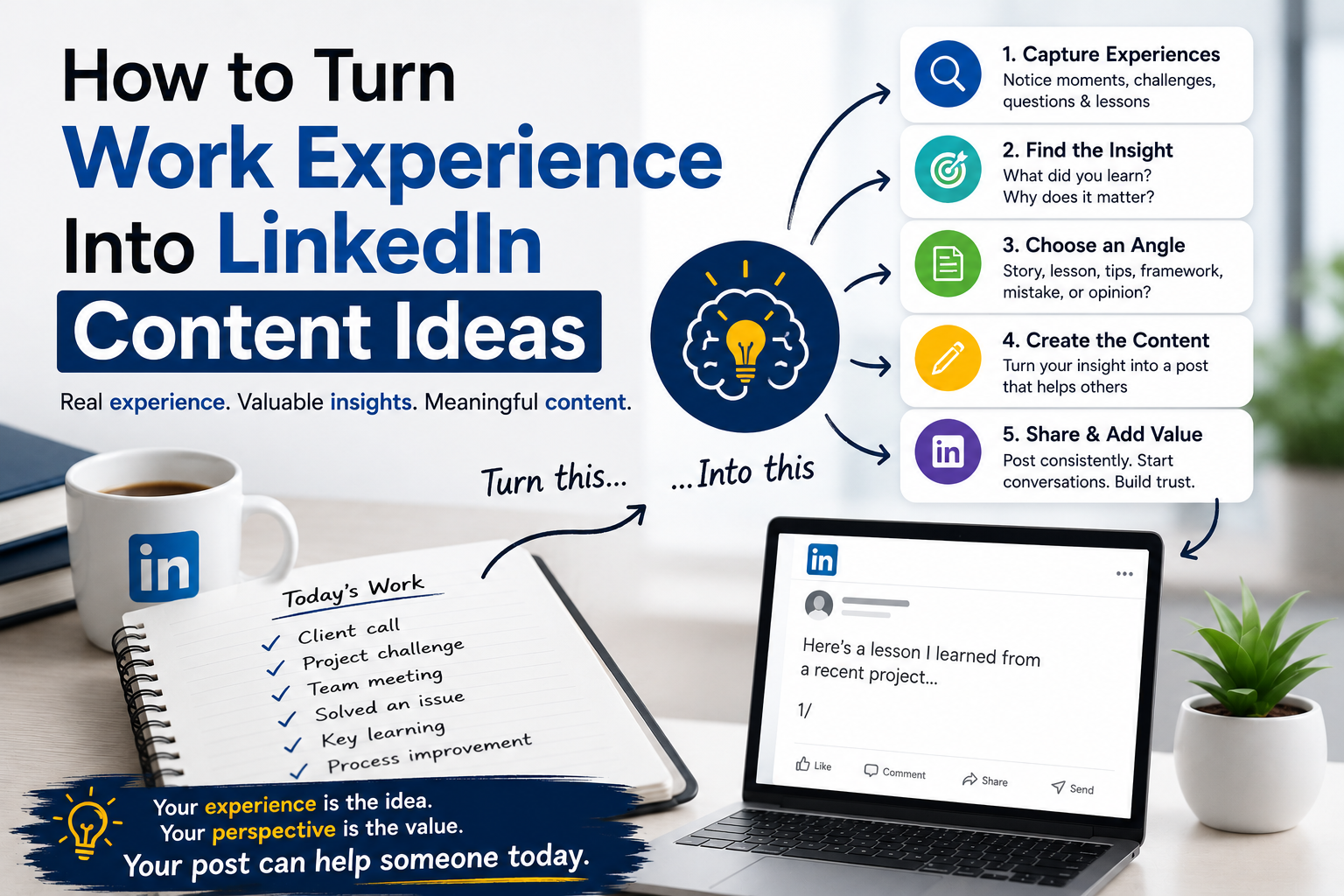
One of the most common reasons professionals don't post consistently on LinkedIn is surprisingly simple:
“I don't know what to post about.”
But for most professionals, the problem is not a lack of ideas.
The problem is that they don't recognize their everyday work as potential content.
You don't need to become a full-time content creator. You don't need to invent a new idea every morning. Your meetings, projects, negotiations, challenges, mistakes, decisions, and professional lessons already contain valuable content.
The key is learning how to turn experience into insight.
This article explains a practical system for finding LinkedIn content ideas from the work you are already doing.
Your Work Is Already a Content Library
Think about everything that happens during a typical work week.
- You solve problems.
- You make decisions.
- You attend meetings.
- You learn from mistakes.
- You manage projects.
- You deal with unexpected challenges.
- You discover better ways of working.
- You change your opinion based on experience.
Each of these can become a LinkedIn post.
The mistake many professionals make is thinking content must come from something extraordinary. In reality, useful content often comes from ordinary professional experiences combined with a useful perspective.
For example, you may think:
“I spent three hours resolving an issue with unclear stakeholder ownership.”
That sounds like a normal work problem.
But it could become a LinkedIn post about:
- Why projects fail when ownership is unclear
- Three questions to define accountability
- The difference between responsibility and ownership
- Why more meetings don't always solve project delays
- A professional mistake you made when managing stakeholders
One experience. Multiple content ideas.
Step 1: Capture What Happens During Your Workday
Don't wait until you sit down to write a LinkedIn post before searching for ideas.
By that time, you may struggle to remember the useful things that happened during the week.
Instead, create a simple content bank.
Whenever something interesting happens, make a short note.
Capture these types of moments:
- A problem you solved
- A difficult decision you made
- A mistake you learned from
- A question someone asked you
- A meeting that changed your perspective
- A process you improved
- An industry trend you noticed
- A professional opinion you changed
- A useful framework you developed
- Something that surprised you
You don't need to write a complete post.
A simple note such as:
“Project delayed because everyone thought someone else owned the final decision.”
is enough to capture the experience.
Later, you can develop it into content.
Step 2: Find the Lesson Behind the Experience
An experience alone is not always a post.
The most valuable part is usually the lesson behind it.
Ask yourself:
- What happened?
- Why did it happen?
- What did I learn?
- What would I do differently next time?
- Could someone else benefit from this lesson?
For example:
Experience: A project took longer than expected.
Observation: The team spent too much time waiting for decisions.
Lesson: Clear decision ownership is as important as project planning.
Content idea: “One reason projects get delayed has nothing to do with resources.”
Now you have a post with a clear professional insight.
Step 3: Use Different Angles for the Same Experience
This is where content creation becomes much easier.
Most professionals think one experience equals one post.
That is not true.
One experience can be viewed from several angles.
Suppose you successfully negotiated a major supplier contract.
You could create content about:
The Story Angle
What was the challenge, and how did you approach it?
The Lesson Angle
What did the experience teach you about negotiation?
The Framework Angle
What three or five factors did you evaluate before making a decision?
The Mistake Angle
What would you do differently if you handled the negotiation again?
The Opinion Angle
What common advice about negotiation do you disagree with?
The Educational Angle
What can someone new to your profession learn from your approach?
The experience remains the same. The perspective changes.
Step 4: Turn Problems Into Useful Content
Some of the best LinkedIn content starts with a problem.
When you solve something difficult at work, ask:
“Would someone else in my profession face this same problem?”
If the answer is yes, you have a potential content idea.
Use this structure:
Problem → Why it happened → What you did → What you learned
For example:
We had a process that required multiple approvals.
The process was slowing down because ownership was unclear.
We defined responsibilities and escalation paths.
The biggest lesson: adding more people to a process doesn't always make it better.
This structure creates practical and credible content because it is based on real experience.
Step 5: Turn Questions Into Posts
Pay attention to the questions people ask you.
Questions from colleagues, customers, stakeholders, and people in your professional network can reveal exactly what your audience wants to understand.
For example:
- How do you evaluate a new supplier?
- How do you prepare for a complex negotiation?
- How do you prioritize competing projects?
- What should professionals learn about AI?
- How do you measure the success of a process?
If one person asks the question, there is a good chance others are wondering about it too.
Instead of answering the same question repeatedly, turn it into useful LinkedIn content.
Step 6: Document Your Professional Growth
You don't need to post only after achieving something major.
Your learning process itself can create valuable content.
Write about:
- Something you are currently learning
- An opinion you changed
- A new skill you are developing
- A better process you discovered
- An assumption that turned out to be wrong
For example:
“I used to think the best negotiation outcome was always the lowest price. Experience taught me to evaluate total value, risk, flexibility, and long-term supplier performance as well.”
This type of post demonstrates professional growth while sharing a useful lesson.
Step 7: Look for Patterns in Your Work
A single event can be interesting.
A repeated pattern can be even more valuable.
Ask yourself:
- What problems keep appearing?
- What mistakes do I see repeatedly?
- What questions are becoming more common?
- What is changing in my industry?
- What process consistently creates delays?
Patterns can become strong thought-leadership content because they are based on repeated professional observation.
For example:
“After working on multiple cross-functional projects, I've noticed that project delays are often blamed on resources. In many cases, the real problem is unclear decision-making.”
That is more than a story. It is a professional observation supported by experience.
A Simple Weekly System for Finding Content Ideas
You don't need to spend hours brainstorming every week.
Try this simple routine.
During the Week
Capture interesting experiences, questions, lessons, and observations in your content bank.
At the End of the Week
Review your notes and select one or two ideas that could help your audience.
Ask These Three Questions
- What happened?
- What did I learn?
- Why should someone else care?
Then choose a format:
- Personal story
- Professional lesson
- Framework
- Checklist
- Industry observation
- Contrarian opinion
- How-to guide
This turns content creation from an occasional brainstorming exercise into a repeatable system.
Don't Share Everything—Protect Confidential Information
Turning work experience into content does not mean sharing confidential information.
Never publish sensitive business details, customer information, financial data, internal strategies, or anything covered by confidentiality obligations.
You can still share the lesson without revealing confidential details.
Instead of naming a company, customer, project, or exact commercial details, focus on the broader professional learning.
For example:
Instead of: “Our customer rejected a specific proposal worth X amount.”
Write: “A recent negotiation reminded me that the lowest price isn't always the most important decision factor.”
Protecting confidentiality while sharing genuine lessons is an important part of professional content creation.
Use AI to Develop the Idea, Not Invent the Experience
AI can make the process faster.
But the strongest starting point is still your real experience.
You provide:
- The situation
- The challenge
- Your perspective
- The lesson
AI can help:
- Find different content angles
- Create potential hooks
- Structure the post
- Improve clarity
- Adapt the content to your preferred writing style
The best workflow is:
Your experience → Your insight → AI-assisted draft → Your review → Final post
That keeps the content authentic while reducing the time required to create it.
Build Your Personal Content Library
Imagine doing this consistently for six months.
Every week, you capture a few useful experiences.
After a few months, you could have dozens of potential LinkedIn content ideas based on things that actually happened in your professional life.
You will no longer need to begin every week by asking:
“What should I post?”
Instead, you can ask:
“Which experience should I share this week?”
Your Experience Is the Differentiator
AI can generate thousands of posts about leadership, productivity, negotiation, technology, or career growth.
What it cannot automatically replicate is your specific experience.
Your decisions.
Your mistakes.
Your observations.
Your lessons.
Your professional journey.
That is where authentic content starts.
You don't need to search endlessly for ideas. Start paying attention to the work you are already doing.
Your next LinkedIn post may already be hidden inside something that happened today.
Turn Your Work Experience Into LinkedIn Content With Propost
You already have the raw material for valuable LinkedIn content. The challenge is organizing your experiences and turning them into posts consistently.
With Propost, you can turn your ideas and professional expertise into LinkedIn content, explore different angles, create drafts, and maintain a writing style that reflects your own voice.
Your work provides the experience. Your perspective creates the value. AI helps you develop the content.
Start turning your professional experience into authentic LinkedIn content with Propost.
Ship LinkedIn posts in your voice
Draft, approve, and publish with Propost — start free, no card required.
Also explore: Pricing · Free LinkedIn tools · Blog · Resources